

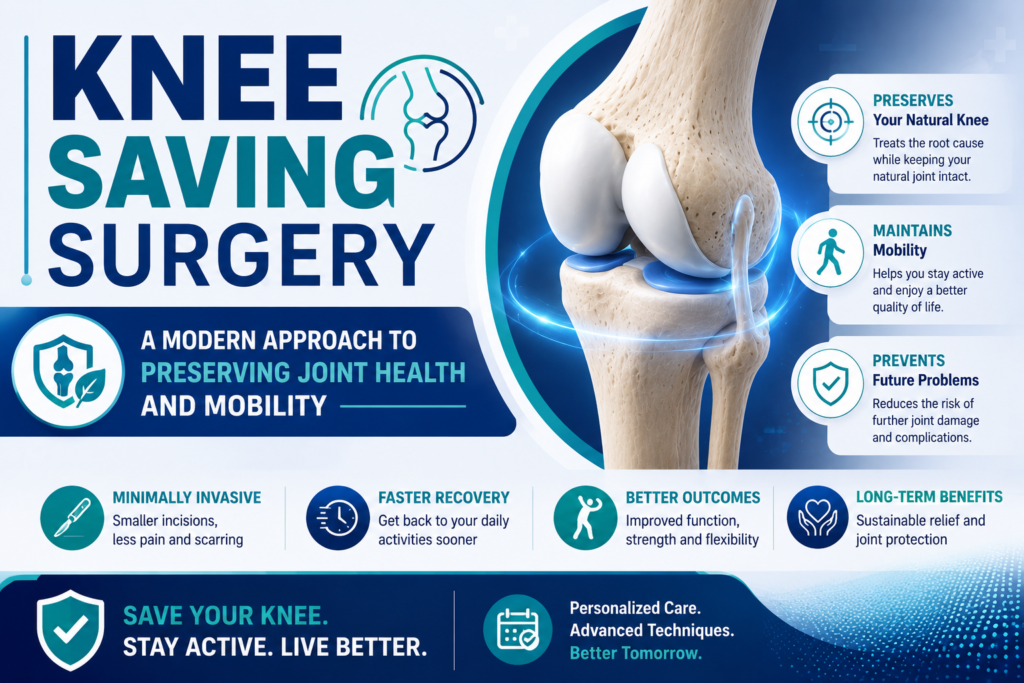
Knee pain is one of the most common orthopedic problems, affecting people of all ages in different ways. It can show up after sports injuries or due to arthritis, ligament damage, or just age-related wear and tear. Still, a lot of people tend to believe that knee issues always mean you need a total knee replacement right away. But over time, orthopedic treatments have improved, and for many patients, there is a more sensible choice: Knee Saving Surgery.
Unlike joint replacement procedures, Knee Saving Surgery focuses on holding onto the natural knee joint whenever it’s possible. As people become more aware of joint preservation, more patients are looking at Knee Saving Surgery as a workable approach for keeping an active lifestyle.
What is Knee-Saving Surgery?
Knee Saving Surgery is an advanced orthopedic procedure meant to keep the natural knee joint, not to swap it out. In general, it is suggested for people who still have workable or relatively healthy parts of the knee and can gain from a more corrective approach.
The main goal of Knee Saving Surgery is to bring back proper alignment, boost joint function, ease pain, and shield healthy cartilage from getting any further damage. By keeping the knee’s natural motion, Knee Saving Surgery can help patients maintain better mobility.
Who Can Benefit from Knee-Saving Surgery?
Not every patient with knee pain necessarily needs a joint replacement. In a lot of cases, a knee-saving procedure might be a suitable option, especially when it comes to:
- Patients with early-stage arthritis
- Individuals with cartilage damage
- People suffering from ligament injuries
- Active adults seeking to maintain mobility
- Younger patients who want to delay knee replacement
- Patients with knee deformities affecting alignment
A very detailed check-up by an orthopedic specialist is essential to see if “Knee Saving Surgery” is really the right option for treatment.
Common Types of Knee-Saving Surgery
Several procedures fall under the category of Knee Saving Surgery. The most appropriate technique depends on the patient’s condition and overall joint health.
1. High Tibial Osteotomy (HTO)
One of the most widely performed forms of knee-saving surgery, High Tibial Osteotomy, kind of involves correcting the alignment of the knee. Basically, by shifting the body weight away from the damaged area, the procedure may relieve pain, and it can also slow down the progression of arthritis.
2. Cartilage Restoration Procedures
Cartilage damage is a common cause of knee pain, and these knee-saving surgery techniques focus on repairing, or even regenerating, the damaged cartilage. This helps patients keep a healthy joint function longer.
3. Ligament Reconstruction
An injury to key knee ligaments can bring about a feeling of unsteadiness and cause longer-term joint wear. Ligament reconstruction is usually wrapped into this bigger idea of “Knee Saving Surgery”; it basically restores stability yet keeps the natural joint in place.
4. Meniscus Preservation Surgery
The meniscus kind of works as a shock absorber inside the knee, really there to cushion stuff. In more modern knee-saving surgery approaches, the priority is usually to repair the meniscus whenever that is possible rather than taking it out.
Benefits of Knee-Saving Surgery
The growing popularity of Knee Saving Surgery is largely due to its numerous advantages.
1. Preserves the Natural Joint
One of the biggest benefits of Knee Saving Surgery is that it helps patients keep their own knee joint, instead of swapping it out with artificial components, which, you know, feels a bit more natural.
2. Delays Joint Replacement
For quite a lot of patients, Knee Saving Surgery can delay the need for a total knee replacement for several years, sometimes even longer.
3. Improved Mobility
Because Knee Saving Surgery keeps the natural parts in place, many patients end up with more natural motion and a more flexible feel after recovery.
4. Better Long-Term Joint Health
If done at the right stage, Knee Saving Surgery can slow the joint breakdown and help a person maintain long-term knee function. It’s kind of a supportive approach that works best when timing and conditions match up.
5. Active Lifestyle Support
Athletes and people who are physically active often lean toward Knee Saving Surgery, because it lets them keep up a higher level of activity. Sometimes it feels more natural to them.
Recovery After Knee-Saving Surgery
Recovery after knee-saving surgery can look different, depending on the exact procedure that was done. In most cases, people go through a planned process, meant to bring back strength, range of motion, and overall steadiness, step by step.
Physical therapy plays a big role in how well knee-saving surgery turns out. It is like the recovery is not just about the operation; it is also about what happens after. Patients are advised to stick to the medical plan, come to their sessions, and slowly work on everyday actions.
The recovery period might be from a few weeks, all the way to several months, but honestly, the long-term advantages of Knee Saving Surgery often make the whole commitment feel worth it, in a way.
When Should You Consider Knee-Saving Surgery?
“Knee Saving Surgery” with an orthopedics specialist, if:
- Knee pain limits daily activities
- Conservative treatments no longer provide relief
- You have been diagnosed with early arthritis
- You experience recurrent knee instability
- You want to avoid or delay knee replacement
Timely evaluation can help determine whether Knee Saving Surgery is suitable for your condition.
Knee Saving Surgery vs Knee Replacement
While both procedures aim to improve quality of life, there are important differences.
Knee Saving Surgery focuses on preserving the patient’s natural joint structure, whereas knee replacement involves removing damaged portions of the joint and replacing them with artificial implants.
For younger and active patients, Knee Saving Surgery is often preferred because it maintains natural knee mechanics. Knee replacement may still be necessary for individuals with advanced joint damage, but Knee Saving Surgery offers an excellent alternative when conditions allow.
Conclusion
Living with knee pain doesn’t always mean you must go straight to a knee replacement. For a lot of patients, Knee Saving Surgery can help; it reduces pain, makes movement easier, and keeps that natural knee joint in place. Instead of just covering symptoms, this approach targets the root cause so patients can remain active and enjoy a better quality of life.
If knee pain is messing with your day-to-day, it’s important to get expert advice early. The right treatment, at the right time, can make a big difference, and Knee Saving Surgery might help you guard your knee health for years.
